What Is a Search Engine and How Does It Work? A Beginner’s Guide
Search engines have become an essential part of everyday internet use. Whether you want to find a website, learn about a topic, compare products, find a location, or answer a question, a search engine can help you discover relevant information.
Most people simply type a few words into a search box and click a result. However, a lot of technology works behind the scenes before those results appear.
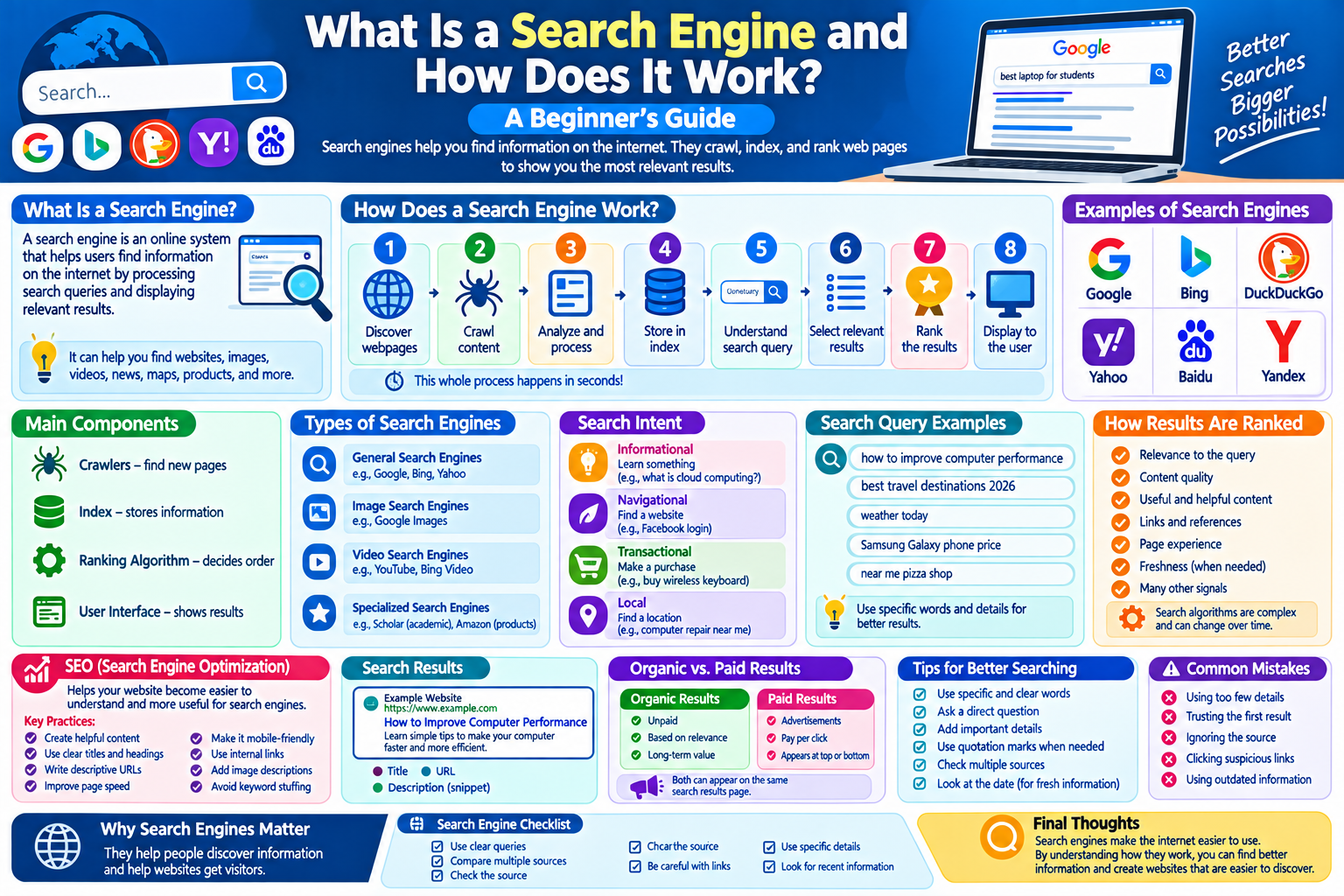
Search engines discover webpages, organize information, understand search queries, and rank results based on many different signals.
In this beginner’s guide, we will explain what a search engine is, how search engines work, how webpages are discovered and indexed, how search results are ranked, and how users can search more effectively.
What Is a Search Engine?
A search engine is an online system that helps users find information on the internet by processing search queries and displaying relevant results.
A search engine can help users find:
- Webpages
- Images
- Videos
- News
- Maps
- Products
- Documents
- Other online information
Search engines use automated systems and large databases to organize information from the web.
Examples of Search Engines
There are several search engines available around the world.
Examples include:
- Bing
- DuckDuckGo
- Yahoo
- Baidu
- Yandex
Different search engines may use different technologies, interfaces, and ranking systems.
How Does a Search Engine Work?
Search engines generally perform several major tasks.
The basic process can be simplified into:
- Discover webpages.
- Crawl available content.
- Analyze and process the content.
- Store useful information in an index.
- Understand a user’s search query.
- Select relevant results.
- Rank the results.
- Display the results to the user.
This process allows search engines to provide answers within a very short time.
What Is Web Crawling?
Web crawling is the process of automatically discovering and visiting webpages.
Search engines use automated programs commonly called crawlers, spiders, or bots.
A crawler can visit a webpage, follow links, discover other pages, and collect information about the content.
The crawler may then report information back to the search engine’s systems for further processing.
What Is a Search Engine Crawler?
A crawler is an automated program designed to discover and inspect webpages.
For example, if a crawler finds a link from one webpage to another, it may follow that link and discover the new page.
This allows search engines to continuously discover new and updated content.
However, crawling does not necessarily mean that a page will appear in search results.
What Is Search Engine Indexing?
After discovering content, a search engine can analyze and store information about webpages in a large database called an index.
This process is known as indexing.
The index can contain information about:
- Page content
- Titles
- Links
- Images
- Structured information
- Other signals about a webpage
When someone performs a search, the search engine can use its index rather than searching the entire internet from scratch.
What Is a Search Query?
A search query is the text a user enters into a search engine.
For example, a user might search:
how to improve computer performance
The search engine analyzes the query to determine what information the user is looking for.
Search queries can be:
- Short
- Long
- Informational
- Navigational
- Transactional
- Local
The search engine attempts to understand the meaning and intent behind the query.
What Is Search Intent?
Search intent describes what a user is trying to accomplish with a search.
For example:
Informational Intent
The user wants to learn something.
Example:
What is cloud computing?
Navigational Intent
The user wants to find a particular website or page.
Example:
Facebook login
Transactional Intent
The user is interested in completing an action, such as purchasing something.
Example:
buy wireless keyboard
Local Intent
The user wants information related to a specific location.
Example:
computer repair shop near me
Understanding search intent helps search engines provide more useful results.
How Are Search Results Ranked?
Search engines generally use many signals to determine which pages should appear for a particular query.
These can include factors related to:
- Relevance
- Content quality
- Page usefulness
- Website accessibility
- Search intent
- Page experience
- Links and references
- Freshness when relevant
Search algorithms are complex and can change over time.
There is no single factor that guarantees a webpage will rank first.
What Is an Algorithm?
A search algorithm is a set of computational processes used to analyze information and determine appropriate search results.
Search engines use sophisticated algorithms to process enormous amounts of information.
These systems can evaluate many signals to determine which results are most useful for a particular query.
Why Do Search Results Change?
Search results can change for many reasons.
For example:
- New webpages are published.
- Existing pages are updated.
- Search algorithms change.
- User search intent changes.
- Information becomes outdated.
- Search engines improve their understanding of queries.
- Competition between webpages changes.
As a result, rankings are not necessarily permanent.
What Is SEO?
SEO, or Search Engine Optimization, refers to practices used to help webpages become easier for search engines to understand and more useful for visitors.
Good SEO generally focuses on creating helpful content and providing a good user experience.
Basic SEO practices can include:
- Writing useful content
- Using descriptive page titles
- Organizing content with headings
- Creating readable URLs
- Improving page speed
- Making websites mobile-friendly
- Adding descriptive image text when appropriate
- Building a logical internal linking structure
SEO is not about guaranteeing a particular ranking.
Why Is Quality Content Important?
Search engines aim to provide useful results to users.
For website owners, creating original and helpful content can make a website more valuable to visitors.
Good content should:
- Answer the reader’s question
- Be accurate
- Be easy to understand
- Avoid unnecessary repetition
- Provide useful details
- Be organized clearly
- Be written for people rather than only for search engines
What Are Search Keywords?
Keywords are words or phrases that describe the topic of a webpage or search query.
For example, an article about operating systems might naturally discuss terms such as:
- Operating system
- Windows
- Android
- Computer software
- System software
Website owners should use relevant terminology naturally rather than repeatedly inserting the same keyword.
What Is Keyword Stuffing?
Keyword stuffing means excessively repeating keywords or phrases in an attempt to manipulate search rankings.
For example, repeating the same phrase many times in unnatural sentences can make content difficult to read.
Instead of keyword stuffing, website owners should focus on clear, useful, naturally written content.
What Are Search Result Snippets?
A search result usually displays a small amount of information about a webpage.
This can include:
- Page title
- Website address
- Description or other search-generated text
This information helps users decide whether a result is relevant to their search.
What Are Organic Search Results?
Organic search results are unpaid results generated by a search engine’s ranking systems.
A webpage can appear in organic results without paying the search engine for each visitor.
Organic visibility is influenced by relevance, content, technical factors, competition, and many other signals.
What Are Search Advertisements?
Search engines may also display paid advertisements alongside organic results.
Advertisers pay according to the advertising system and campaign setup.
Paid advertisements and organic search results are different, although both can appear on the same search-results page.
What Is Voice Search?
Voice search allows users to perform searches using spoken commands rather than typing.
People can use voice assistants on:
- Smartphones
- Smart speakers
- Cars
- Computers
- Other connected devices
Voice searches are often phrased as natural questions.
How to Search More Effectively
You can improve your search results by using clear and specific queries.
Use Specific Words
Instead of:
computer
try:
how to speed up a slow Windows computer
Ask a Direct Question
For example:
What is an IP address?
Add Important Details
If you are looking for a particular type of information, include relevant details.
For example:
beginner guide to cloud storage
Use Quotation Marks When Appropriate
Quotation marks can be useful when you want to search for an exact phrase on search engines that support this feature.
How Search Engines Help Website Owners
Search engines can send visitors to websites through organic search results.
For website owners, search engines can help people discover:
- Articles
- Services
- Products
- Business information
- Educational resources
- Other useful content
Creating a technically accessible website and publishing useful content can improve the chances of being discovered.
Common Search Engine Mistakes
Searching With Too Few Details
Very broad searches can produce too many unrelated results.
Trusting the First Result Automatically
The first result is not necessarily the best answer for every question.
Ignoring the Source
Always consider who published the information, especially for important topics.
Clicking Suspicious Results
Be careful with unusual websites, misleading titles, and unexpected downloads.
Using Outdated Information
Some topics change quickly, so check publication dates and current sources when freshness matters.
How Website Owners Can Make Pages Search-Friendly
Website owners can follow some basic practices:
- Create original, useful content.
- Use clear page titles.
- Organize articles with headings.
- Write descriptive URLs.
- Make pages mobile-friendly.
- Improve loading performance.
- Add useful internal links.
- Use descriptive image information where appropriate.
- Fix broken links.
- Keep important information updated.
Search Engine Checklist
For users:
- Use clear search queries.
- Add specific details.
- Compare multiple sources.
- Check important information carefully.
- Be cautious with suspicious websites.
- Look at the date when freshness matters.
For website owners:
- Publish helpful content.
- Use descriptive titles.
- Organize content clearly.
- Make pages mobile-friendly.
- Improve website speed.
- Avoid keyword stuffing.
- Keep content updated.
- Make the website easy to navigate.
Frequently Asked Questions
1. What is a search engine in simple words?
A search engine is an online system that helps users find relevant information on the internet.
2. How does Google find websites?
Search engines use automated crawlers to discover webpages, follow links, and collect information that can be processed and potentially added to their indexes.
3. What is search engine indexing?
Indexing is the process of analyzing and storing information about webpages so that search engines can retrieve relevant pages when users perform searches.
4. Does SEO guarantee a first-place ranking?
No. SEO can help make a website more accessible and understandable, but search rankings depend on many factors and no legitimate SEO method can guarantee a specific position.
5. Why do search results differ between people?
Search results can vary because of factors such as location, language, device, search history, personalization, query wording, and changes in search systems.
6. Is every website listed in search engines?
No. Search engines do not necessarily crawl, index, or display every webpage. Technical issues, website configuration, content quality, accessibility, and other factors can affect whether a page appears in search results.
Final Thoughts
Search engines are complex systems that help people discover information across the internet. They use crawling, indexing, query understanding, and ranking processes to provide results that are relevant to users.
For internet users, learning how to create specific searches and evaluate sources can make online research more effective.
For website owners, the best long-term approach is to create useful, original, well-organized content and provide visitors with a fast, accessible, and easy-to-use website.