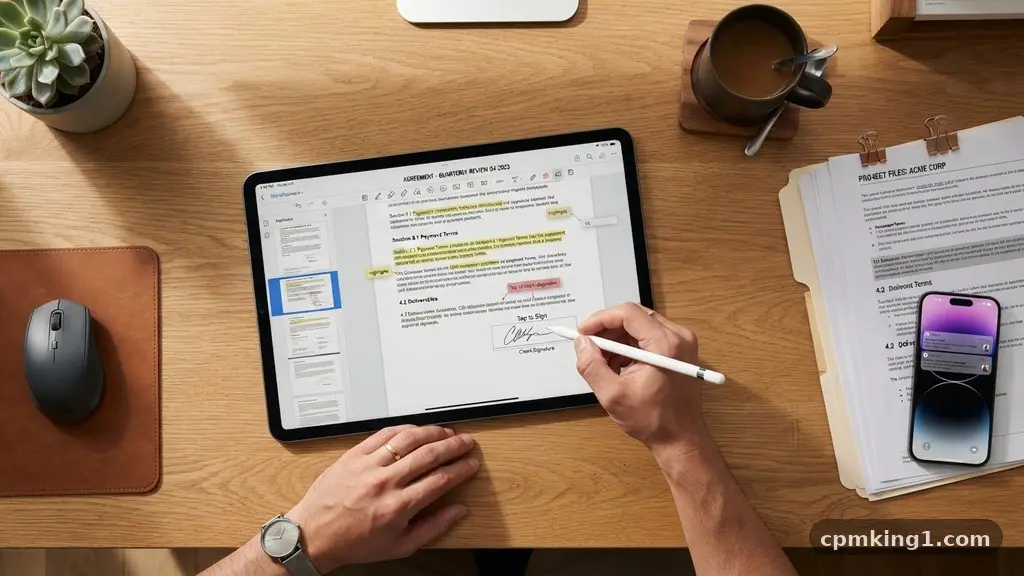
Finding the right software for choosing a PDF Tool for Editing, Signing, and Organizing Documents can feel overwhelming given the sheer number of options available today. You want a solution that balances power with simplicity, ensuring your workflow remains smooth rather than becoming a technical hurdle.
By focusing on your specific needs—whether that involves basic form filling, heavy-duty redaction, or team collaboration—you can narrow the field significantly. This article will help you identify the essential features that matter most for your productivity, ensuring you invest your time and resources in a platform that truly serves your goals.
Assessing Your Primary Document Workflow
Before you dive into technical specifications, take a moment to consider what you actually do with your files daily. If your work mostly involves signing contracts or simple form filling, a lightweight, user-friendly interface will serve you better than a bloated professional suite.
Conversely, if you are handling complex legal documents that require redaction tools, advanced OCR technology, or heavy-duty security encryption, you must prioritize software designed for high-stakes document management. Many people make the mistake of overpaying for features they never use, or conversely, struggling with a basic free tool that lacks the necessary power for their professional requirements.
Think about the source of your files. Do they arrive as scanned images that need text recognition, or are they born-digital documents that are already searchable? If you deal with many scans, prioritize a tool that excels in optical character recognition.
If you work in a team environment, you should look for software that offers collaborative editing, allowing you to track changes or leave comments without creating multiple versions of the same file. By defining your primary tasks first, you create a clear checklist that prevents you from getting distracted by flashy, unnecessary marketing features.
Evaluating Security and Privacy Standards
Security is not a luxury when you are handling sensitive information. When you are choosing a PDF Tool for Editing, Signing, and Organizing Documents, investigate how the software handles your data. Does it offer robust security encryption for files stored locally or in the cloud?
If you work with confidential documents, ensure the tool complies with industry standards, such as those discussed on the International Organization for Standardization website regarding information security management. A common mistake is to ignore the fine print regarding data privacy, especially when using free cloud-based editors that might scan your documents for advertising purposes.
Check if the software allows for password protection or digital signature verification. These features provide a layer of trust, especially when sending documents to clients or external partners. If you use a tool that relies heavily on cloud storage integration, verify that the provider uses end-to-end encryption.
You want to be confident that your files are not just accessible to you, but also protected from unauthorized access during transmission or while sitting on a server. Never compromise on security for the sake of convenience, as a single data leak can have lasting consequences for your professional reputation.
Understanding the Importance of Cross-Platform Compatibility
In our modern work environment, you rarely stay at one desk all day. You might start a task on your desktop computer, review it on a tablet during your commute, and make final adjustments on your phone. Choosing a tool that offers seamless cross-platform compatibility is essential for maintaining momentum.
Test whether the mobile application feels like a crippled version of the desktop software or if it provides a consistent experience. Many users find that while a web-based editor works well on a browser, the mobile app experience varies significantly depending on the developer.
Look for tools that synchronize your work across devices through reliable cloud storage integration. If you edit a document on your laptop, the changes should appear almost instantly on your phone or tablet. Avoid tools that require you to manually export and import files every time you switch devices.
This manual process is a major source of friction and often leads to version control errors where the wrong document gets sent to a recipient. A truly efficient tool acts as a single source of truth for your documents, regardless of the hardware you are currently holding.
Mastering Form Filling and Electronic Signatures
The ability to sign documents electronically is often the primary driver for people searching for a new PDF tool. However, there is a distinct difference between a simple electronic signature, which is essentially an image of your signature, and a cryptographically secure digital signature.
If you work in industries like law, real estate, or finance, you need a tool that supports verifiable signatures that can prove a document hasn’t been altered after being signed. Ensure the tool you pick handles form filling gracefully, automatically recognizing fields and allowing for quick, accurate data entry.
A common pitfall is choosing software that makes the signature process cumbersome for the recipient. If your clients have to create an account or download specific software just to sign your document, you are introducing unnecessary friction into your business relationships. Look for tools that allow for a web-based signing experience, where recipients can simply click a link and sign via their browser.
This approach is much more professional and ensures that your document turnaround times remain as short as possible. Test the form-filling capabilities with a complex document to see if the tool respects formatting or if it causes the layout to shift unexpectedly.
Utilizing Advanced Editing and Organization Features
Once you move beyond basic signatures, you might find you need more control over the document structure itself. Advanced editing features allow you to reorder pages, merge multiple PDFs into one, or extract specific pages for a client.
Batch processing is another feature that can save you hours of work; it allows you to apply the same action, like adding a watermark or converting to a specific format, to hundreds of files at once. If you frequently handle large archives, look for robust file compression capabilities to keep your document storage manageable without sacrificing quality.
Annotation features are equally important for collaborative work. Whether you are reviewing a colleague’s report or marking up a proposal, having the ability to highlight, underline, or add sticky notes directly onto the PDF streamlines communication. Avoid tools that force you to convert the PDF into a Word document just to make edits.
While conversion tools like Adobe Acrobat have improved significantly, they can still struggle with complex layouts or proprietary fonts. Staying within the native PDF format is almost always safer for maintaining the integrity of the document’s design and legal standing.
The Role of Redaction and Document Protection
If you handle legal or medical files, redaction tools are a non-negotiable requirement. Simply placing a black box over text in a PDF is not sufficient; a sophisticated user can often remove that box and read the sensitive information underneath. A professional-grade PDF tool will physically remove the data from the file, ensuring that the hidden information is truly gone.
This is a critical distinction that can prevent significant privacy breaches. If you are choosing a PDF Tool for Editing, Signing, and Organizing Documents for a corporate environment, make sure your IT team has cleared the software for these specific security tasks.
Beyond redaction, consider how the tool manages document permissions. Can you set a document to be “read-only” to prevent others from copying text or printing the file? These granular controls are vital when you need to share information while still maintaining ownership and intellectual property rights.
Many users overlook these settings until they encounter a situation where a document was modified by an unauthorized party. Spending a little extra time to understand the permission settings in your software can save you from significant headaches in the future.
Efficiency Through Batch Processing and Automation
Efficiency is the ultimate goal of adopting any new piece of technology. If you find yourself performing the same repetitive tasks—renaming files, converting formats, or applying security stamps—you should look for automation features.
Batch processing allows you to line up a queue of documents and let the software work through them while you focus on more creative or strategic tasks. Even if you don’t think you need it now, as your document volume grows, you will eventually reach a point where manual processing becomes a bottleneck that drains your productivity.
Think about how well the tool integrates with your existing tech stack. Does it talk to your email client, your cloud storage provider, or your project management software? Some tools offer plugins that let you sign or edit documents directly within your browser or email interface.
This reduces the number of clicks required to get a job done. When you are choosing a PDF Tool for Editing, Signing, and Organizing Documents, prioritize those that offer an open ecosystem. A tool that plays well with others is always a better long-term investment than a closed, proprietary system that forces you to change your entire workflow to suit its limitations.
Frequently Asked Questions
Is it necessary to pay for a premium PDF editor?
For basic tasks like viewing or simple signatures, a free tool might suffice. However, if you require professional features like OCR technology, advanced redaction, or batch processing, a premium tool is usually necessary. These paid versions offer better security, more reliable performance, and dedicated support, which are often worth the investment for professional document management.
Can I safely edit sensitive financial documents in the cloud?
Cloud-based editing is safe provided you use a reputable provider that employs strong security encryption and follows strict privacy protocols. Always check if the service is SOC2 compliant or meets other relevant security standards. If you are dealing with highly classified information, you may prefer a desktop-based tool that keeps your files entirely offline.
How do I know if a PDF tool supports OCR?
Most professional PDF editors will list optical character recognition as a core feature. You can test this by uploading a scanned image of a document; if the software allows you to highlight and copy the text within that image, it has successfully used OCR technology. This feature is essential for making scanned archives searchable and editable.
What is the difference between a digital and electronic signature?
An electronic signature is essentially a digital mark that indicates an agreement, but it may not be legally verifiable. A digital signature uses a certificate-based ID to verify that the document was signed by a specific person and has not been altered since. If you need to ensure the legal integrity of a contract, a digital signature is the superior choice.
Conclusion
Selecting the right software is about finding a balance between the specific tasks you perform and the security you require. By focusing on your actual workflow needs, you can avoid paying for unnecessary features while ensuring you have the tools to handle redaction, signing, and organization efficiently. Remember that the best choice is one that integrates well with your existing devices and keeps your data secure at every step.
Now that you have a clearer understanding of what to look for, take an audit of your current document habits. Identify the one feature that would solve your biggest daily frustration, and prioritize that when evaluating your next software purchase.
Whether you are a solo professional or part of a larger team, choosing a PDF Tool for Editing, Signing, and Organizing Documents is an investment in your long-term productivity. Take your time to test a few options, and don’t hesitate to reach out to vendors if you have specific questions about their security or compatibility.